Have you ever planned to study for hours… but ended up doing almost nothing?
You sit down with your books.
You open first page.
A few minutes later you’re checking your phone, feeling bored or thinking about doing something else.
Then the guilt appears.
You start asking yourself:
“Why am I so lazy when it comes to studying?”
But the truth is most students are not actually lazy.
Usually the real problems are things like:
- too many distractions
- unclear study plans
- mental exhaustion
- overwhelming workloads
When these things build up studying starts to feel stressful and difficult.
The good news is that you don’t need extreme motivation to fix this.
Sometimes all you need is a simple reset plan that helps you rebuild your study habits step by step.
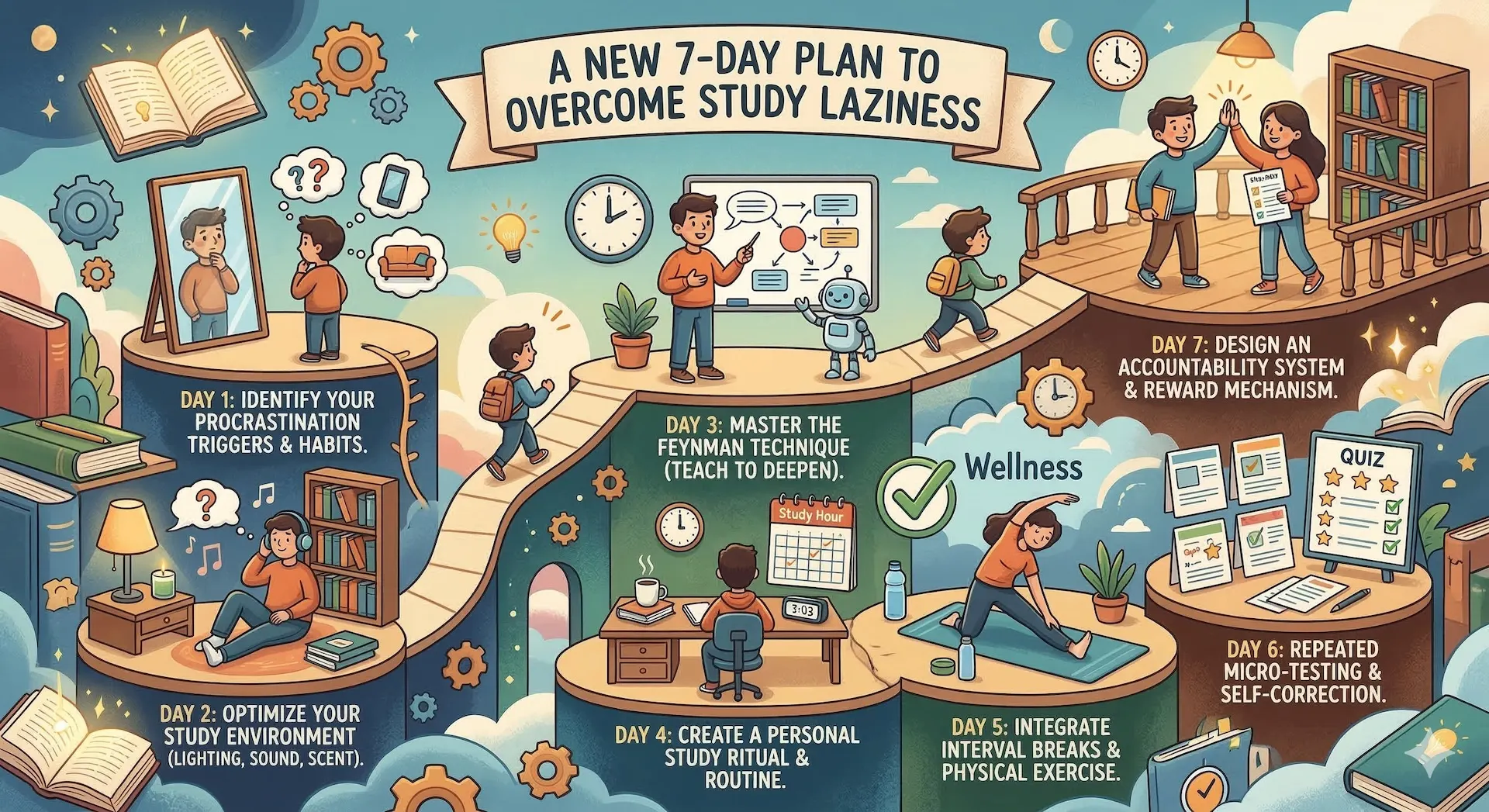
Quick Overview of the 7-Day Plan
| Day | Focus | What You Should Do |
|---|---|---|
| Day 1 | Study Environment | Clean and organize your study desk |
| Day 2 | Study Planning | Create a simple and realistic study schedule |
| Day 3 | Easy Start | Begin studying with an easy subject |
| Day 4 | Focus Technique | Use the 25-minute focus method |
| Day 5 | Remove Distractions | Reduce phone and social media use |
| Day 6 | Revision | Review what you studied earlier |
| Day 7 | Reflection | Evaluate your study habits and improve |
This plan helps you rebuild your study routine gradually instead of forcing discipline overnight.
Day 1 — Reset Your Study Environment
Your environment plays a big role in your ability to focus.
If your desk is messy or full of distractions your brain finds it harder to concentrate.
Before trying to study harder improve your surroundings.
Action Steps
✔ Clean your study desk
✔ Remove unnecessary papers
✔ Organize your books and notes
✔ Turn off unnecessary notifications
✔ Keep only the materials you need
A clean environment makes studying feel much easier.
Day 2 — Create a Realistic Study Plan
Many students struggle because they don’t know exactly what they should study.
They sit down and think:
“I should study today.”
But that’s too vague.
Instead create a simple plan with clear tasks.
Example plan:
- 30 minutes mathematics practice
- 25 minutes science revision
- 20 minutes reviewing notes
Clear goals make it easier for your brain to start.
Day 3 — Start With the Easiest Subject
If motivation is low then starting with difficult topics can make studying feel even harder.
Instead begin with something simple.
For example:
- revising a familiar chapter
- reviewing notes
- solving basic questions
Early success creates momentum.
Once you begin continuing becomes easier.
Day 4 — Use 25-Minute Focus Method
Trying to study for hours without breaks often leads to distraction.
A better method is studying in short focused sessions.
The 25-Minute Method
- Choose a specific study task
- Study for 25 minutes with full focus
- Take a 5-minute break
- Repeat the cycle
Short sessions help your brain stay focused and avoid burnout.
Day 5 — Reduce Phone Distractions
Phones are one of the biggest reasons students struggle to focus.
Notifications and social media constantly interrupt attention.
Even a few seconds of phone use can break concentration.
Action Steps
✔ Put your phone away while studying
✔ Turn on silent or focus mode
✔ Avoid social media during study sessions
Reducing phone distractions can greatly improve productivity.
Day 6 — Review What You Studied
Revision is one of the most powerful learning techniques.
Instead of always studying new topics spend time reviewing what you already learned.
You can:
- reread your notes
- summarize key ideas
- solve practice questions
Revision strengthens memory and understanding.
Day 7 — Reflect and Improve
The final day is about learning from your experience.
Ask yourself questions like:
- What helped me study better this week?
- What distracted me the most?
- Which study method worked best?
- What should I change next week?
Reflection helps you build a better study routine.
Simple Daily Study Template
You can follow this simple study structure each day.
| Study Session | Duration |
|---|---|
| Study Session 1 | 25 minutes |
| Short Break | 5 minutes |
| Study Session 2 | 25 minutes |
| Short Break | 5 minutes |
| Study Session 3 | 25 minutes |
Total focused study time: 75 minutes
Even this small amount of focused study can produce excellent results.
Common Mistakes Students Make
Many students accidentally make studying harder.
Avoid these common mistakes.
❌ Trying to study for very long hours suddenly
❌ Studying while checking phone frequently
❌ Skipping sleep to study longer
❌ Studying without clear goals
❌ Comparing yourself too much with other students
Improving these habits can make studying easier.
Frequently Asked Questions
Students often feel lazy due to distractions, overwhelming workloads, lack of planning, or mental fatigue.
Start with small tasks, study in short sessions, and remove distractions like phones.
Consistency matters more than long hours. Even 1–2 focused hours daily can be very effective.
Final Thoughts
Feeling lazy to study is something most students experience.
But in many cases laziness is simply a sign that your study system needs improvement.
You don’t need perfect motivation.
You only need small consistent steps.
Start with Day 1.
Clean your study space.
Make a simple plan.
Study for just 25 minutes.
Small actions today can completely change your study habits over time.