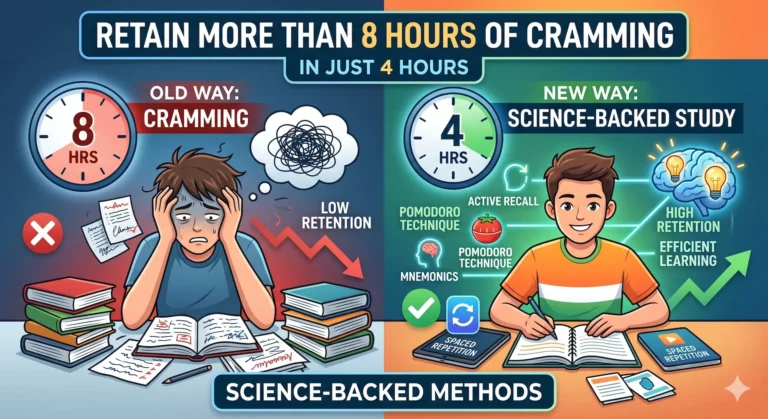
We all have been there sometime : You spend hours cramming for exam, feel confident walking in and two weeks later you can barely remember basics. Sound familiar?
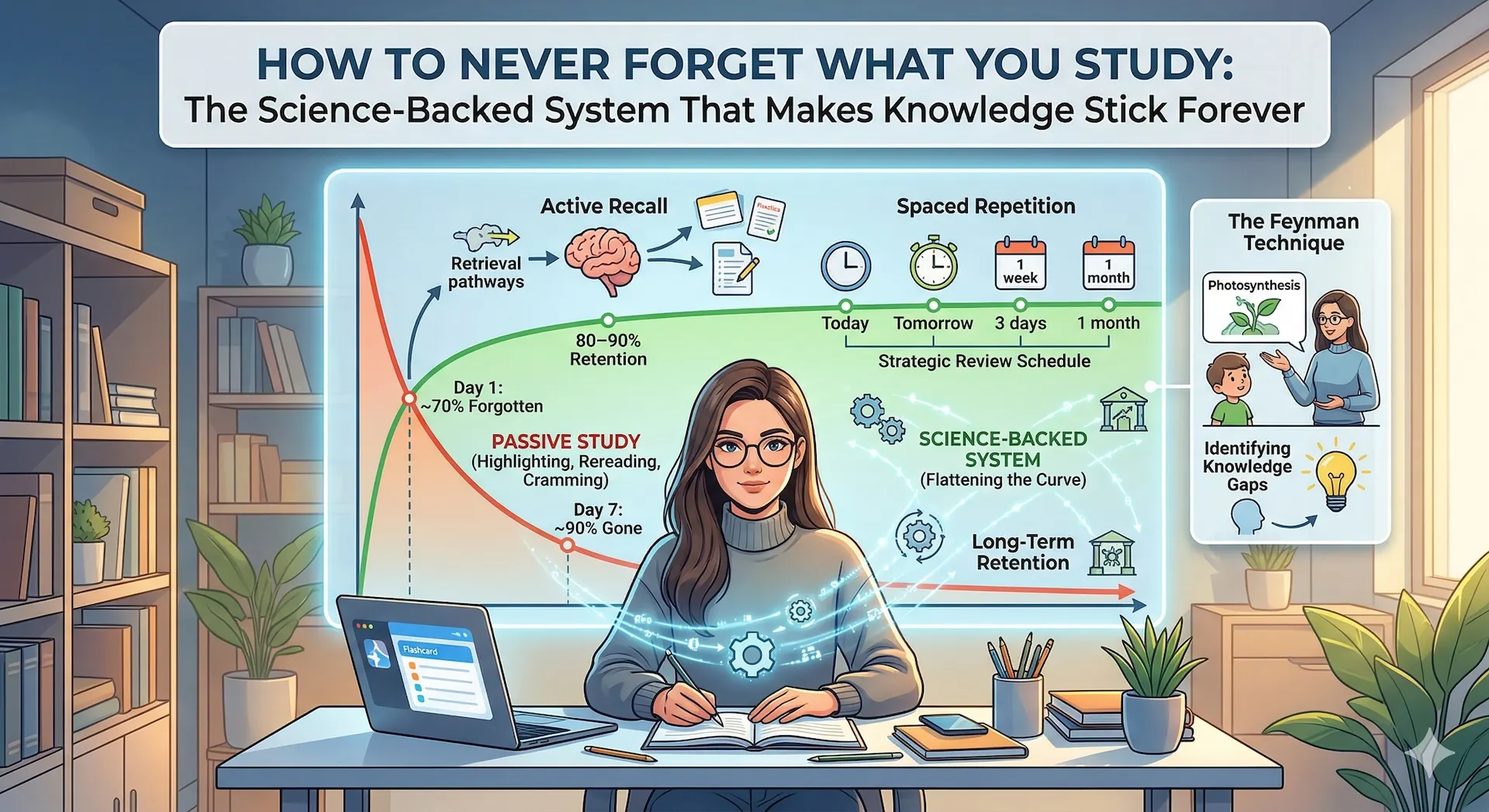
The truth is that your brain is designed to forget. Famous Ebbinghaus Forgetting Curve shows that without proper reinforcement we lose about 70% of new information within 24 hours and up to 90% within a week. Traditional study methods like highlighting, rereading notes or passive reviewing can actually accelerate forgetting.
But here is a good news because of decades of cognitive science have identified a small set of techniques which can flatten that curve dramatically. Students and professionals who use them routinely retain 80–90% of what they learn for months or even for years.
In this comprehensive guide we will walk you through exactly how to do it. No fluff no “just work harder” advice just proven actionable strategies you can start using today. Whether you’re a student preparing for competitive exams, a professional upskilling or a lifelong learner, this system will change how you study forever.
1. First, Understand the Enemy: The Ebbinghaus Forgetting Curve
Hermann Ebbinghaus, a 19th-century psychologist discovered that memory decay follows a predictable pattern. Right after learning something new retention drops sharply then levels off at a low baseline.
Without intervention this curve looks brutal:
- Day 1: ~70% forgotten
- Day 7: ~80–90% gone
- Long term: Only fragments remain
The secret weapon? Strategic repetitions timed at exact moments when you’re about to forget. Each well-timed review dramatically slows the decay.
Visualize two curves: one plunging steeply (passive study) and another that stays high because of smart reinforcement. That’s the difference between forgetting 80% and remembering 80%.
2. Active Recall: Single Most Powerful Study Technique
Stop rereading. Close the book. Force your brain to retrieve information.
Active recall (also called retrieval practice) is the #1 technique backed by hundreds of studies. It works because it strengthens the exact neural pathways you will use during exams or real-life application.
How to do it properly:
- Cover your notes and write down or speak everything you remember.
- Use flashcards: Question on front, answer on back.
- Take practice tests without looking anything up.
- Explain concepts out loud as if teaching someone.
The numbers are staggering:
- Medical students using active recall scored 50% higher on final exams.
- One-week retention jumped from 34% (rereading) to 80%.
- Real-world application of concepts improved by 70%.
The harder you struggle to recall, stronger the memory becomes. That slight discomfort is your brain building long-term strength.
Pro tip: Make cards “effortful.” Vague questions like “What is photosynthesis?” are weak. Strong ones: “Draw and label the light-dependent reactions of photosynthesis, including all key molecules.”
3. Spaced Repetition: Review at Perfect Time
Timing matters as much as the method. Spaced repetition schedules reviews just before you’re about to forget—today, tomorrow, in 3 days, 1 week, 1 month, 3 months, etc.
This technique directly attacks forgetting curve. Meta-analyses of over 200 studies confirm spaced practice beats cramming by a huge margin for long-term retention.
Real-world example: Imagine learning Spanish vocabulary. With massed practice (cramming one day), you might remember 60% after a week. With spaced repetition same effort yields 90%+ retention after months.
4. The Feynman Technique: Learn by Teaching Like a Genius
Richard Feynman, the Nobel Prize-winning physicist had a simple rule: “If you can’t explain it simply then you don’t understand it well enough.”
Step-by-step process:
- Choose a concept.
- Explain it in plain language as if to a 5-year-old (or actually teach a friend).
- Identify where you get stuck or use jargon that’s your knowledge gap.
- Return to source material, fix the gap and simplify again.
- Repeat until explanation is crystal clear.
This technique forces deep understanding rather than surface memorization. It combines perfectly with active recall and spaced repetition.
Example: Trying to explain “supply and demand” in economics? Weak version: “When supply goes up, price goes down.” Feynman version: “Imagine 10 people selling ice cream on a hot day versus 10 people wanting ice cream. What happens to the price? Now flip it—only 2 sellers on a freezing day. See how the curves interact? That’s market deciding price without anyone in charge.”
5. Bonus Habits That Multiply Your Results
These supporting strategies turn good retention into exceptional:
- Teach someone else (or record yourself explaining). Teaching is one of the highest forms of active recall.
- Interleave topics instead of blocking. Mix math problems with different concepts in one session it improves discrimination and problem-solving by up to 40%.
- Sleep on it. Review material right before bed; your brain consolidates during sleep.
- Handwrite notes + speak aloud. Both actions engage more brain regions than typing.
- Exercise and nutrition. Even 20 minutes of aerobic exercise boosts memory formation via BDNF (brain-derived neurotrophic factor).
- Memory palaces & mnemonics for lists and sequences (ancient technique still used by memory champions).
6. Your Complete Daily System to “Never Forget”
Here’s the exact workflow top performers use:
- Learn actively — Use Feynman while taking initial notes.
- Create Anki cards immediately (aim for 10–20 high-quality cards per study session).
- Review daily with Anki (10–20 minutes).
- Weekly deep dive — Teach the entire topic to someone (or an imaginary student).
- Monthly big-picture test — Do a full practice exam covering older material.
- Track progress — After 30 days, test yourself on content from week 1. You’ll be shocked how much sticks.
Total daily investment: 45–60 minutes of focused work. Results: near-perfect long-term retention.
Final Thoughts: Consistency Beats Intensity
You don’t need more hours or more willpower. You need to replace passive studying with active retrieval + smart spacing + deep explanation.
Start small. Pick one subject today, create 10 Anki cards using active recall, and run your first review session. In two weeks you’ll notice the difference. In two months it will feel like magic.
The brain is not a filing cabinet it’s a muscle. Train it right way and it will reward you with knowledge that lasts a lifetime.
Ready to transform how you study? Download Anki right now, pick one topic, and apply the first two techniques today. Your future self will thank you.
Share this guide with any student or learner in your life. The techniques work for everyone, from school kids to PhD researchers.
Stay curious. Study smarter. Remember everything.