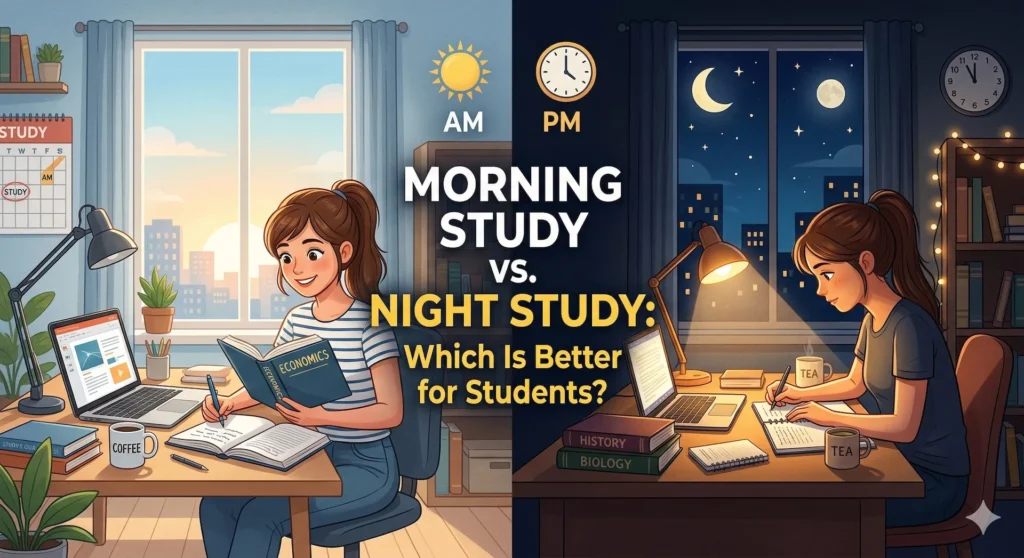
Every student has faced when should you have to study. Should you wake up at 5 AM with birds and crack open your books while world is still quiet or burn midnight oil when house is finally peaceful and distractions melt away? With exams, assignments and the pressure to perform, choosing “right” study time feels like it could make or break your GPA. But here is truth backed by science: there is no one-size-fits-all answer. The best time to study depends on your chronotype your body’s natural internal clock along with sleep quality, energy levels and what you’re studying.
In this detailed guide, we’ll break down pros and cons of morning vs night study, dive into the latest research (including 2023–2025 studies) and give you practical tips to discover what works for you. Whether you’re a Class 10 board exam warrior, a JEE/NEET aspirant or a college student juggling lectures and late night deadlines then this post will help you study smarter not harder.
How Does Academic Integrity Violation Affect You and Your Future?
Understanding Chronotypes: Are You a Lark, Owl or Dove?
Your chronotype is your biological preference for when you feel most alert and productive. It’s largely genetic but influenced by age, lifestyle and light exposure.
- Morning Larks (about 25–30% of people): Naturally wake early, feel sharpest in the morning and wind down by evening.
- Night Owls (about 25–30%): Peak later in the day/evening, struggle with early mornings and often feel most creative at night.
- Doves/Intermediates (the rest): Flexible middle ground, performing well across whole day.
Teens and young adults (common among students) tend to shift toward evening types due to puberty and screen time but school schedules often force early starts which lead to chronic sleep debt for owls.
Research consistently shows a synchrony effect: You perform best when your study schedule matches your chronotype. Fighting it leads to poorer focus, retention and even lower grades.
So you are smart but if you are lark and studying in late night then you might not learn as much as you can learn in morning with same efforts.
Morning Study: The Fresh-Mind Advantage
Pros for Students:
- Sharper memory and recall: After 7–9 hours of sleep, your brain is refreshed. Morning sessions excel at absorbing facts, formulas, dates and new concepts (perfect for theory subjects like history, biology, or language).
- Fewer distractions: No notifications, family interruptions or social media noise. Natural daylight boosts alertness and mood via serotonin and vitamin D.
- Builds discipline and routine: Starting your day with study creates momentum, reduces procrastination and leaves evenings free for revision or relaxation.
- Better long-term health: Aligns with school/college timings in most places (like India), reducing sleep disruption.
Cons:
- Night owls feel groggy and unmotivated early.
- Real-life interruptions (traffic, family breakfast) can creep in.
- Less ideal for creative or problem-solving tasks that need “flow” state.
Studies support this: Morning chronotypes often achieve higher grades overall, partly because they get better sleep when schools start early.
Night Study: The Quiet, Creative Powerhouse
Pros for Students:
- Deeper focus and creativity: Fewer distractions mean better immersion in complex topics like math proofs, coding or essay writing. Many owls report peak problem solving after 8 PM.
- Memory consolidation boost: Studying right before sleep helps your brain process and store information during REM and slow wave sleep great for revision.
- Quiet environment: Late nights offer true peace, especially in busy households.
- Flexibility for college students: Research from the University of Nevada, Reno (2017, still relevant) found college students learn best between 11 AM and 9:30 PM, with evening types outnumbering morning types 2:1.
Cons:
- Sleep sabotage: Late sessions often push bedtime, leading to shorter, poorer quality sleep. Evening chronotypes already face higher risks of fatigue and lower alertness in morning classes.
- Diminishing returns: Fatigue builds after 10 PM for most, reducing efficiency.
- Health trade-offs: More caffeine, blue light exposure and irregular meals.
What Does Latest Science Say? (2023–2025 Research)
Science has moved beyond “morning is always better.” Key takeaways:
- Morning types edge out in grades: Multiple studies (2024–2025) show morning chronotypes score higher academically, even after adjusting for class times—likely due to consistent sleep.
- But timing matters hugely: A 2025 study of 100,000+ exams found peak passing rates around midday (11 AM–1 PM). Early morning or late afternoon exams showed lower success.
- Synchrony wins: When classes match chronotype, performance gaps shrink. Late chronotypes suffer most in early schedules but thrive later.
- Hybrid reality: Morning for new learning + analytical tasks; afternoon/evening for integration and creativity. One 2025 analysis noted 65% of students peak mornings, 30% evenings.
Bottom line: Forcing wrong time can cost 20–30% in retention. Match your biology.
Best Time to Study: Morning, Afternoon, or Night!
How to Find Your Perfect Study Time (Practical Student Guide)
- Track your energy for 7–10 days: No alarms on weekends. Note when you feel most focused, creative, or sleepy.
- Take a quick chronotype quiz: Search for the Morningness-Eveningness Questionnaire (free online) or apps like “Sleep Cycle.”
- Experiment like a scientist:
- Week 1: Morning-only study (5–9 AM).
- Week 2: Evening-only (7–11 PM).
- Compare retention with practice tests and how you feel.
- Factor in your goals:
- New concepts/math/science → Morning or early afternoon.
- Revision/creative work → Evening.
- Exams at specific times → Align practice sessions to exam slot.
Non-negotiables for both times:
- 7–9 hours of sleep (no exceptions).
- 5–10 minute breaks every 50 minutes (Pomodoro).
- Natural light in the morning + dim lights at night.
- No heavy screens 1 hour before bed.
Smart Hybrid Strategy Most Students Swear By
- 5–8 AM: New material, problem-solving.
- 10 AM–1 PM: Deep work or lectures.
- 7–10 PM: Revision + light review.
- Sleep by 11 PM max.
This combo leverages best of both worlds and prevents burnout.
Final Verdict: The Winner Is… You
Morning study often wins for consistency, memory and academic performance in structured systems. Night study shines for focus and creativity if you protect your sleep. But the real champion? Studying at your peak chronotype hours while prioritizing sleep and consistency.
Stop copying what works for your topper friend. Audit your own biology, experiment for two weeks and build a schedule that feels sustainable. Your future self (and your grades) will thank you.
What’s your chronotype—lark, owl, or dove? Drop it in the comments and share your best study hack. If this helped, share with a fellow student grinding for boards or competitive exams!
Stay consistent. Study smart. Sleep well. 🌅🌙