Are you tired of spending endless hours hunched over textbooks only to forget most of it next day? You’re not alone. Traditional “more hours = better results” studying creates an illusion of productivity but delivers poor long-term retention.
The good news? You can achieve superior results in 4 focused hours than in 8 hours of passive re-reading or highlighting. Cognitive science shows that quality trumps quantity when you use techniques like active recall, spaced repetition and strategic session structuring.
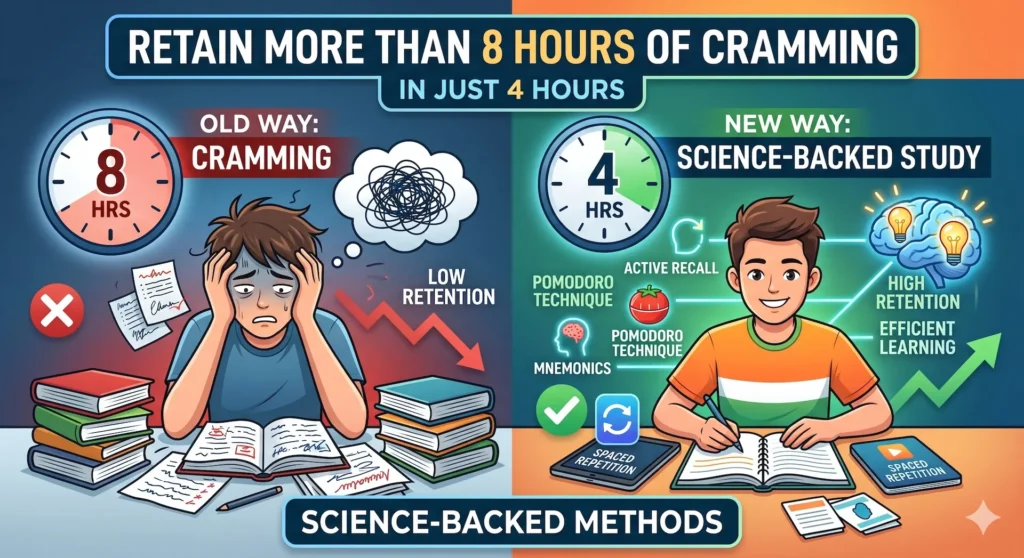
The Problem with Traditional Studying
Passive methods feel comfortable but fail spectacularly:
- Re-reading notes creates fluency illusion — you recognize information but can’t retrieve it.
- Highlighting and summarizing give minimal retention gains.
- Cramming leads to quick forgetting (up to 70% within 24 hours via the Forgetting Curve).
Meta-analyses confirm: Distributed practice (spaced repetition) and practice testing (active recall) rank as most effective techniques with strong effect sizes far outperforming common habits.
1. Master Active Recall: Test Yourself Ruthlessly
Active recall forces your brain to retrieve information strengthening memory pathways far better than passive review.
Studies show students using active recall retain ~80% of material after a week compared to just 34% with passive methods. It can boost exam performance by around 30% or more.
How to do it:
- Close your books and write or speak everything you remember about a topic.
- Use flashcards or self-quizzing apps.
- Blurting: Dump knowledge on blank paper then check gaps.
- Immediately review and correct mistakes.
This “desirable difficulty” builds robust retrieval strength.
2. Harness Spaced Repetition to Beat Forgetting
Space reviews at increasing intervals instead of massing them together. This leverages spacing effect for dramatically better long-term retention — up to 50% or more improvement over cramming.
Practical tips:
- Review new material next day then after 3 days, 1 week, etc.
- Use Anki or similar apps with built-in algorithms.
- Prioritize weaker topics.
One classic study showed spaced practice led to superior results even years later.
3. Structure Your 4 Hours Around Brain Biology (Ultradian Rhythms)
Your brain doesn’t sustain peak focus for 8 hours straight. It follows ~90-minute ultradian cycles of high and low energy.
Optimized 4-hour block (e.g., morning deep work):
- 3–4 sessions of 50–90 minutes focused work + 15–30 minute breaks.
- Or hybrid Pomodoro: 25/5 cycles stacked into longer ultradian blocks.
In each block tackle 1–2 topics with heavy active recall and problem-solving. Real breaks (walk, hydrate, stretch) recharge you. This yields 3+ hours of true deep work — more effective than distracted marathon sessions.
4. Use Feynman Technique for True Mastery
Named after physicist Richard Feynman this method involves explaining concepts simply as if teaching a child.
Steps:
- Choose a concept and explain it in plain language (on paper or aloud).
- Identify gaps where you struggle.
- Return to sources, fill gaps and simplify further.
- Refine until crystal clear.
This exposes weaknesses, builds deeper neural connections and improves both understanding and retention. It’s active, iterative and transforms superficial knowledge into mastery.
5. Bonus High-Impact Strategies
- Interleaved practice — Mix topics instead of blocking one at a time. This improves discrimination and real-world application.
- Pre-testing — Test yourself before learning material. It primes brain for better encoding.
- Sleep and timing — Study then sleep. Consolidation happens offline. Multiple shorter daily sessions beat one long one.
- Handwrite notes when possible for better encoding.
- Minimize distractions: Phone in another room, consistent environment.
Sample 4-Hour Daily Study Routine
- Session 1 (75–90 min): New material + Feynman explanations + initial recall.
- Break (20–30 min): Move, snack, reset.
- Session 2 (75 min): Practice problems + interleaved review.
- Break.
- Session 3 (60–75 min): Weak areas via active recall and spaced reps.
- Quick close (30 min): Plan tomorrow + light review.
Track what you recall correctly each day. Adjust based on results.
Why 4 Quality Hours Beat 8 Average Ones
Elite performers in fields from music to athletics rarely exceed 4 hours of deliberate practice daily. Your brain has limits — pushing beyond with low-intensity work leads to diminishing returns and burnout.
These methods force effortful retrieval and desirable difficulty which feel harder in moment but encode knowledge deeply. Students report covering more ground with better grades and less total time.
Final Thoughts: Start Small, Stay Consistent
Pick one or two techniques today — maybe active recall + Anki for spaced repetition and integrate them. Replace one passive hour with focused retrieval practice.
Consistency compounds. In weeks you’ll study less, remember more and feel more confident.
What’s your biggest study struggle right now? Drop a comment below — active recall on weak topics, time management, or motivation? Share your wins as you experiment with these methods.
Save this post, try routine for one week and watch your retention transform.
You’ve got this. Study smarter, not longer. 🚀