You forget most things after 2 days because of how your brain is wired to prioritize efficiency over perfect recall. This is a well-documented phenomenon explained primarily by Ebbinghaus Forgetting Curve.
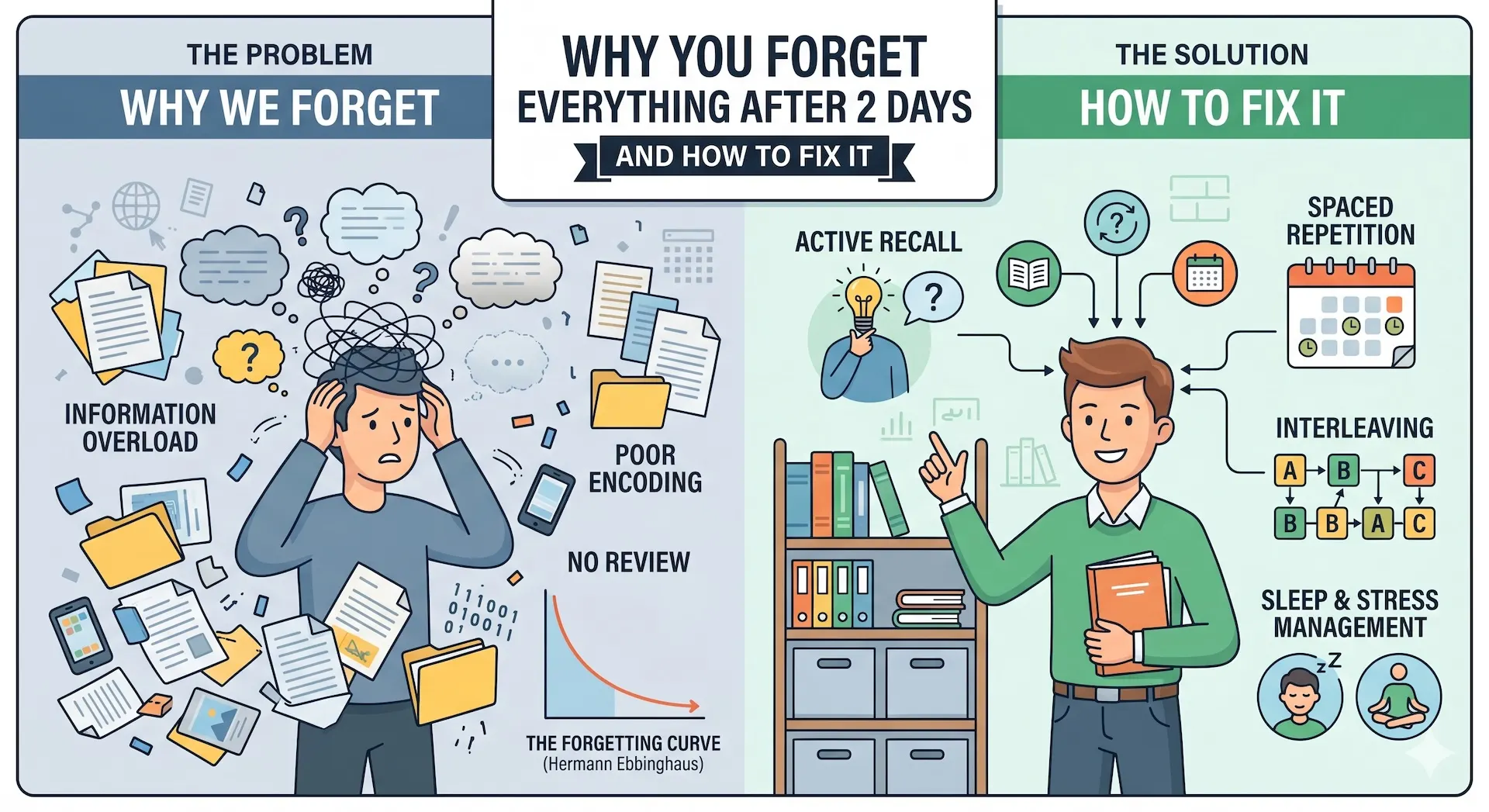
Why This Happens (The Science)
In 1880s, psychologist Hermann Ebbinghaus tested his own memory using nonsense syllables. He found that without any effort to retain new information:
- You lose ~50% within an hour.
- ~70% within one day.
- Most of rest within a few days to a week (this curve flattens after initial steep drop).
Your brain actively discards information it deems non-essential. This is adaptive—it prevents overload from flood of daily inputs but it backfires for learning, studying or skills you want to keep.
Key contributing factors:
- Passive learning (re-reading notes, highlighting or listening without testing yourself) creates weak encoding. Information stays in short-term memory and fades fast.
- Lack of reinforcement: Memories need repeated retrieval to move from short-term to long-term storage (consolidation).
- Interference: New information crowds out old especially in a distracted world.
- Lifestyle issues: Poor sleep (critical for memory consolidation), high stress (cortisol disrupts the hippocampus), lack of exercise or poor nutrition accelerate forgetting.
- No emotional or practical relevance: The brain prioritizes meaningful, used or emotionally charged info.
Forgetting isn’t a flaw—it’s a feature but you can hack the system.
How to Fix It: Evidence-Based Strategies
The best ways directly counter the forgetting curve: strengthen initial encoding and use strategic retrieval.
- Active Recall (The Most Powerful Technique) Close the book/notes and force yourself to retrieve information from memory. Test yourself with questions, explain concepts out loud or write summaries from scratch. This is far superior to passive review because it strengthens neural pathways. Even struggling to recall helps (the “testing effect”).
- Spaced Repetition Review material at increasing intervals: soon after learning (e.g., same day), then 1 day later, 3 days, 1 week, 2 weeks, etc. This flattens forgetting curve dramatically. Each review makes memory more durable so you need less frequent checks over time.
- Combine Them (The Gold Standard) Use tools like Anki or Quizlet for flashcards with built-in spaced repetition algorithms. Example workflow:
- Learn → Immediately test yourself (active recall).
- Review after 1 day → 3 days → 1 week, etc.
- Mix topics (interleaving) instead of blocking one subject for hours.
- Other High-Impact Habits:
- Sleep 7-9 hours: Memory consolidation happens during deep sleep.
- Exercise regularly: Boosts blood flow to brain and supports new neuron growth.
- Teach or apply it: Explaining to others or using knowledge in real scenarios cements it.
- Mnemonics & Chunking: For lists/facts, use stories, acronyms or group info.
- Minimize distractions & stress: Focus deeply during learning sessions.
Realistic Expectations
You won’t remember everything forever, nor should you. Aim to remember what matters by prioritizing key concepts and reviewing efficiently. With consistent active recall + spaced repetition, retention can jump from <20% after a week to 80%+ long-term.
Start small: After your next learning session spend 10-15 minutes testing yourself and schedule first review for tomorrow. Over a few weeks this becomes a habit that transforms how much you retain. Your brain is capable— it just needs right signals to keep important stuff.