In the age of AI-powered tools, infinite digital canvases and overwhelming information, effective note-taking remains one of the highest-leverage skills for students, professionals and lifelong learners. Two of the most enduring systems—Cornell Notes and Mind Mapping—continue to dominate discussions in 2026. But which one is right for you?
The short answer: It depends on your goals, learning style, subject matter and how you review. Neither is universally superior. Many top performers use a hybrid approach leveraging strengths of both amplified by modern digital and AI tools.
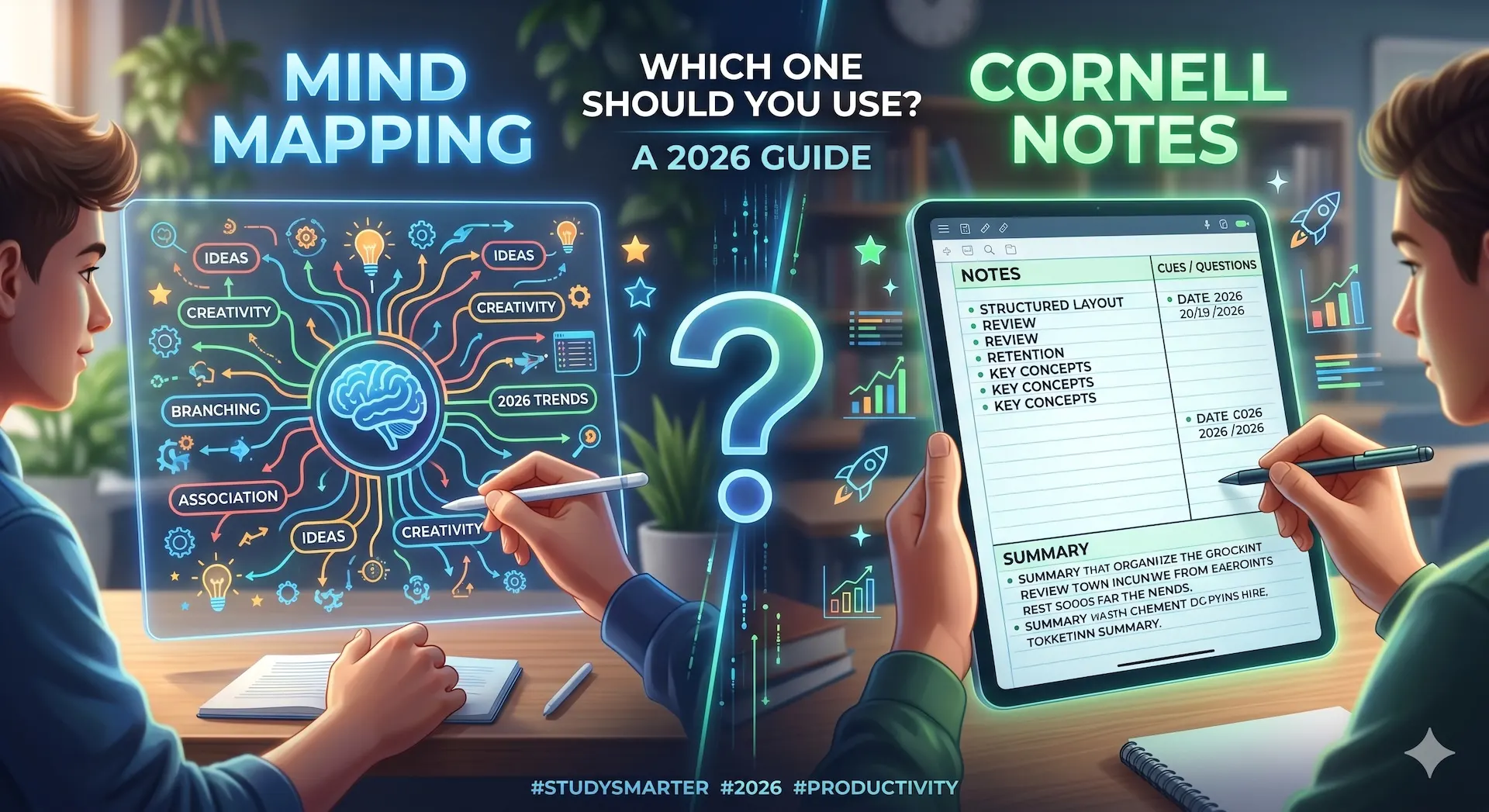
This detailed guide breaks down each method, compares them directly, explores real-world use cases and shares practical recommendations for 2026.
What Are Cornell Notes?
Developed in 1940s by Cornell University professor Walter Pauk, Cornell Method is a structured, linear note-taking system designed for efficient capture and active recall.
How it works:
- Divide your page (or digital template) into three sections:
- Right column (Notes): Main space for detailed notes during lecture, reading or meeting. Use concise phrases, bullet points and your own words.
- Left column (Cues): Narrower area for keywords, questions or prompts added after initial note-taking.
- Bottom section (Summary): 2–5 sentences summarizing key takeaways, written in your own words.
The review process is key: Cover right column and use cues to test yourself (active recall), then refine summary. This turns passive notes into a powerful study tool.
What Is Mind Mapping?
Popularized by Tony Buzan, Mind Mapping is a visual, radial technique that mirrors how brain naturally associates ideas.
How it works:
- Start with a central image or word representing main topic.
- Draw main branches for primary subtopics then smaller branches for details.
- Use colors, icons, images, arrows and keywords (avoid long sentences).
- Emphasize connections and hierarchies visually.
Mind maps excel at showing relationships, fostering creativity and providing a “big picture” overview at a glance.
Pros and Cons: Side-by-Side Comparison
| Feature | Cornell Notes | Mind Mapping |
|---|---|---|
| Structure | Linear, hierarchical, text-heavy | Radial, nonlinear, visual |
| Best For | Lectures, detailed sequential info, exams, fact recall | Brainstorming, complex systems, visual learners, creativity |
| Capture Speed | Fast during live sessions | Slower in real-time; better post-session |
| Review & Retention | Excellent for self-testing & structured review | Excellent for holistic understanding & memory via visuals |
| Creativity | Moderate | High |
| Messiness Risk | Low | Higher (especially on paper) |
| Digital Ease | Easy templates in Notion, OneNote | Thrives in dedicated apps (infinite canvas) |
| Scalability | Great for dense linear content | Can overwhelm with too much detail |
Cornell Strengths: Promotes active engagement and turns notes into ready-made flashcards. Ideal for linear thinkers and high-stakes testing.
Cornell Weaknesses: Can feel rigid; less effective for seeing interconnections or inspiring new ideas.
Mind Map Strengths: Boosts engagement, creativity and long-term retention through dual coding (words + visuals). Perfect for synthesizing information.
Mind Map Weaknesses: Harder to capture fast-paced lectures; can become cluttered without discipline.
When to Choose Each in 2026
Choose Cornell Notes if:
- You’re in lecture-heavy or sequential courses (history, law, medicine, programming syntax).
- You need quick, organized capture followed by efficient review.
- Preparing for exams that reward detailed recall.
- You prefer text-based, scannable formats.
Choose Mind Mapping if:
- Dealing with interconnected topics (biology ecosystems, literature analysis, business strategy, project planning).
- You’re a visual or kinesthetic learner.
- Brainstorming ideas or planning creative work.
- Wanting to generate insights and see “forest” rather than just trees.
2026 Power Move: Hybrid Systems + AI
The most effective users combine both:
- Take raw notes in Cornell format during class or initial reading (structured capture).
- Later convert key concepts into a Mind Map for synthesis and deeper connections.
This hybrid leverages Cornell’s discipline with Mind Mapping’s creativity.
Digital and AI enhancements make this seamless in 2026:
- Notion, Obsidian, OneNote: Cornell templates + embedded mind maps.
- Miro, Coggle, MindMeister, XMind, Boardmix: Powerful mind mapping with collaboration and AI features.
- AI Tools (e.g., Atlas, Notion AI, specialized mind map generators): Auto-generate maps from transcripts or notes, suggest connections, create quizzes from Cornell cues or summarize content.
- Voice-to-text + AI transcription turns lectures into structured notes instantly.
Practical Tips for Implementation
- Start simple: Use paper for a week with each method on same material to compare.
- Templates: Download or create reusable Cornell templates. For mind maps, practice “one keyword per line” rule.
- Review routine: For Cornell—10 minutes daily using cue column. For mind maps—redraw or expand them periodically.
- Digital workflow: Scan handwritten notes or use apps that support both (e.g., GoodNotes on iPad).
- Track results: Measure retention with self-quizzing or practice tests. Adjust based on what improves your performance.
Final Recommendation
In 2026, best note-taking system is the one you use consistently and that aligns with your needs. For most academic and professional scenarios start with Cornell Notes for reliable capture and review then enhance with Mind Maps for deeper understanding. Embrace digital tools and AI to remove friction and multiply effectiveness.
Experiment, iterate and remember: Great notes aren’t about method—they’re about active processing and regular review. The real goal is better comprehension, retention and application of knowledge.
What note-taking system are you using right now? Have you tried a hybrid? Share your experiences in the comments—I’d love to hear what works for you in 2026!
Happy note-taking!