We’ve all been there. You sit down with best of intentions. Notes are open. Laptop is ready and then the thought hits: I just don’t feel like studying.
Motivation vanishes. Your phone suddenly becomes most interesting object in the universe. You tell yourself you’ll start in ten minutes… and three hours later you’re still scrolling.
The truth is, waiting to “feel like it” is one of the most reliable ways to never start. Motivation is unreliable. What works better is understanding how your brain actually decides to act and then hacking those mechanisms.
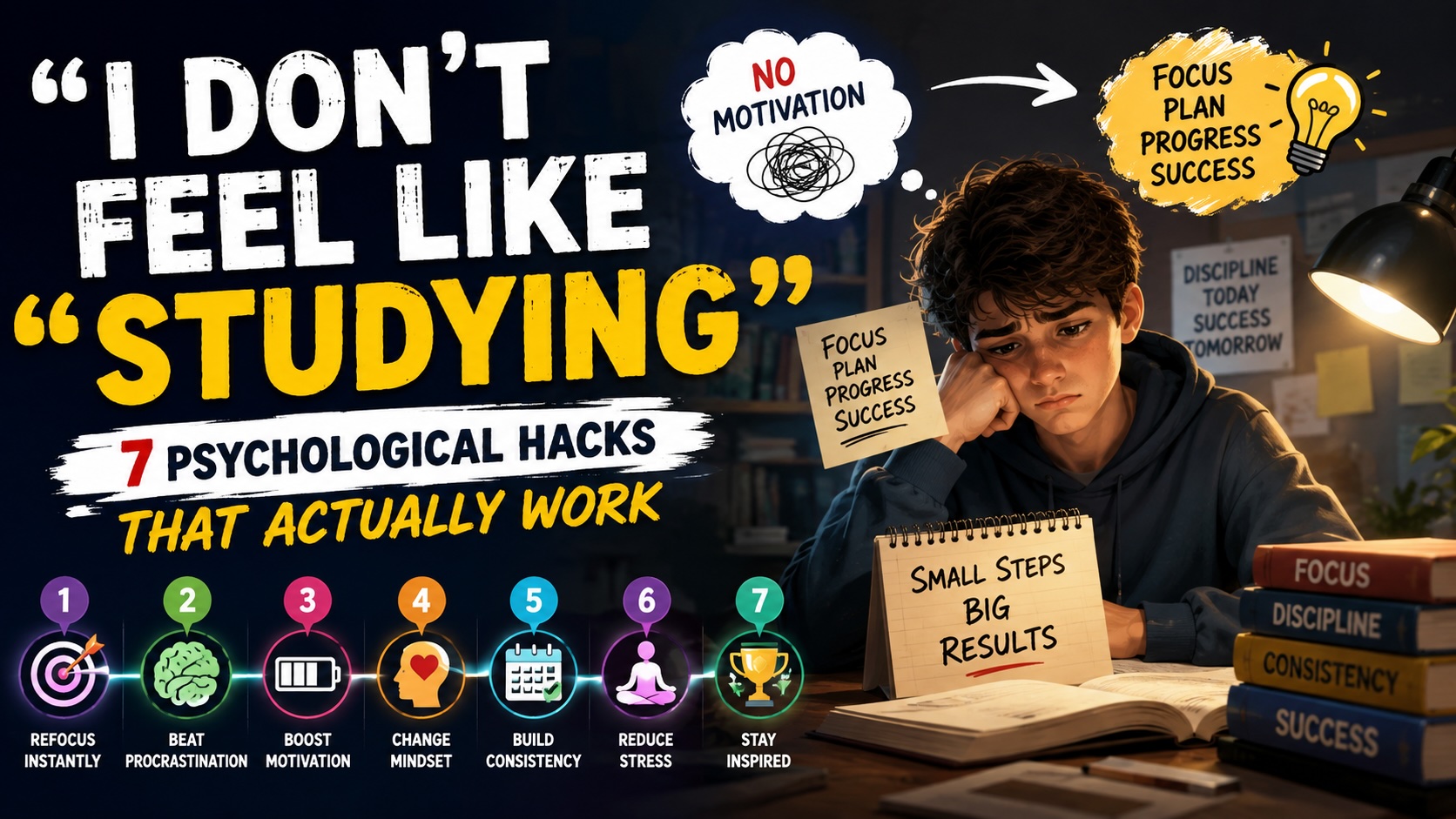
Here are seven psychological hacks that help you study even when you have zero motivation. These aren’t motivational pep talks. They’re practical techniques grounded in behavioral psychology, cognitive science and real-world student experience.
1. The 2-Minute Rule (Lower the Activation Energy)
The hardest part of studying is almost never studying itself. It’s starting.
Your brain treats large, undefined tasks as threats. Bigger and vaguer task feels (“study for three hours”), more resistance you feel. Solution is to make starting point absurdly small.
How to use it: Tell yourself you only have to study for two minutes. Set a timer. Open material. Read one page, review five flashcards or write a single sentence. When timer goes off, you are free to stop.
Most of the time you won’t stop. Once you’re moving, momentum takes over but even if you do stop after two minutes, you’ve still beaten resistance and created a small win.
This works because it dramatically lowers “activation energy” — the mental cost of beginning an action. Small starts bypass brain’s threat response.
2. Rewrite Language in Your Head
The words you use shape what feels possible.
When you say “I have to study but I’m tired,” the word “but” creates a mental dead end. It frames tiredness as a valid reason to stop. Replace it with “and.”
“I have to study and I’m tired.” Suddenly both things can be true at same time. You’re no longer forced to choose between them.
Even more powerful is simple phrase “So what?” When thought “I don’t feel like studying” appears, say out loud: “So what?” It interrupts emotional loop and reminds you that feelings are temporary data, not commands.
Language isn’t just description — it’s instruction to your brain. Small shifts in wording reduce psychological friction that keeps you stuck.
3. Break the Task Until It Feels Harmless
Big goals create overwhelm. Overwhelm triggers avoidance.
Instead of “Study Chapter 7,” break it into the smallest possible actions:
- Open the textbook to page 142
- Read the first two paragraphs
- Write down three key terms
- Explain one concept out loud
Start with easiest item on the list. Completing something tiny gives your brain a hit of progress which makes next step feel less threatening.
This is opposite of “just push through” advice. You’re not forcing yourself to be a productivity machine. You’re making work so small that resistance has nothing to grab onto.
4. Temptation Bundling (Pair “Should” with a “Want”)
Your brain is constantly calculating effort versus reward. Studying often loses that calculation because reward (good grades, future success) is distant while effort is immediate.
Temptation bundling changes equation. You only allow yourself something you enjoy while you study.
Examples:
- Listen to your favorite podcast or playlist only during study sessions
- Drink a special coffee or tea only when you’re at your desk
- Study in a café you like
- Allow yourself a favorite snack only after the first 25 minutes of focused work
Research on temptation bundling (notably by behavioral scientist Katy Milkman) shows that pairing a behavior you should do with something you want to do significantly increases follow-through. You’re no longer relying on pure willpower — you’re giving your brain an immediate reason to cooperate.
5. Use Implementation Intentions (“If-Then” Plans)
Vague intentions fail. Specific plans succeed.
An implementation intention is a simple “If X, then Y” statement that decides the action in advance:
- “If it is 7:00 p.m. and I feel resistance then I will sit at my desk and open my notes for two minutes.”
- “If I catch myself reaching for my phone then I will put it in the other room and start a 25-minute timer.”
By deciding ahead of time you remove the need to negotiate with yourself in moment when willpower is weakest. Studies on implementation intentions consistently show they increase likelihood of following through on difficult behaviors.
Write your if-then plans down. The act of writing makes them more concrete and harder to ignore.
6. Trigger Zeigarnik Effect
The Zeigarnik effect is psychological tendency for unfinished tasks to stay more active in memory than completed ones. Your brain hates open loops.
You can use this deliberately. Start any tiny piece of the work so the task registers as “in progress.” Once it’s open, your mind will keep gently pushing you to return and close it.
Practical application: Even if you only have five minutes, open document, write title of the section you’re supposed to study or answer one practice question. The unfinished nature of the task creates a mild mental tension that makes it easier to come back later.
This is why “just start” is more powerful than it sounds. Starting creates a psychological hook that pure intention never does.
7. Change the Context and Remove Friction
Environment shapes behavior more than we like to admit.
If you always study in the same place where you also scroll, nap or watch videos that space becomes associated with distraction. Change the context:
- Move to a different room, a library or a café
- Clear your desk completely night before
- Put your phone in another room or in a timed lockbox
- Lay out exactly what you need so next action requires almost zero decisions
Reducing friction and changing environmental cues makes starting feel less like a battle and more like natural next step. Over time new environment itself begins to trigger focus.
Putting It All Together
On a low-motivation day you don’t need to use all seven hacks at once. Start with simplest sequence:
- Notice resistance and say “So what?”
- Commit to only two minutes
- Open easiest possible material in a prepared space
- After timer, decide whether to continue
Most of the time continuing feels easier than you expected. Motivation often appears after you start, not before.
The deeper shift is this: stop treating motivation as a prerequisite. Treat action as trigger that creates motivation. Your feelings will catch up. They almost always do.
You don’t need to feel ready. You just need to make first move small enough that your brain stops arguing with it.
Start with two minutes. The rest tends to follow.